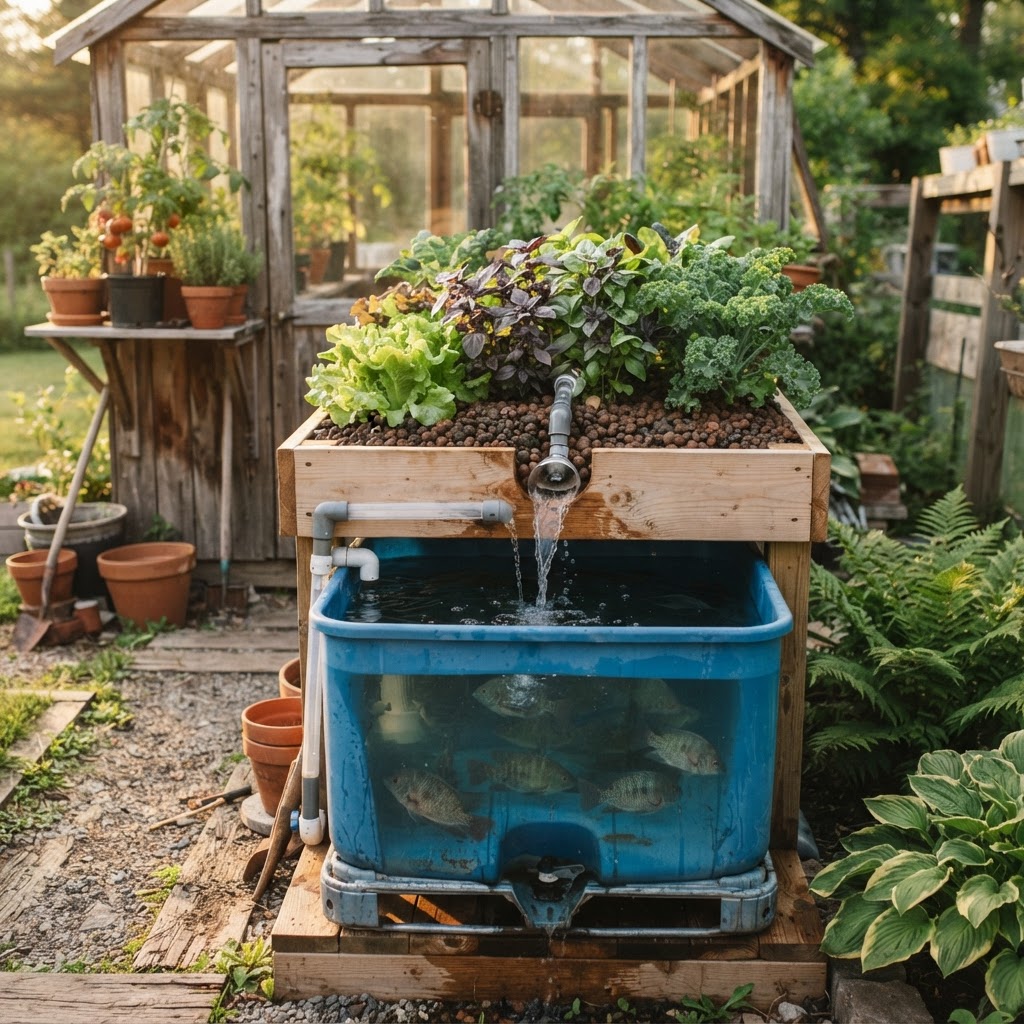
Field Guide · Closed-loop growing
Small-Scale Aquaponics
Fish feed the plants, plants clean the water. Build a backyard system from a single tote in a weekend, then size it exactly with our planner.
How it works
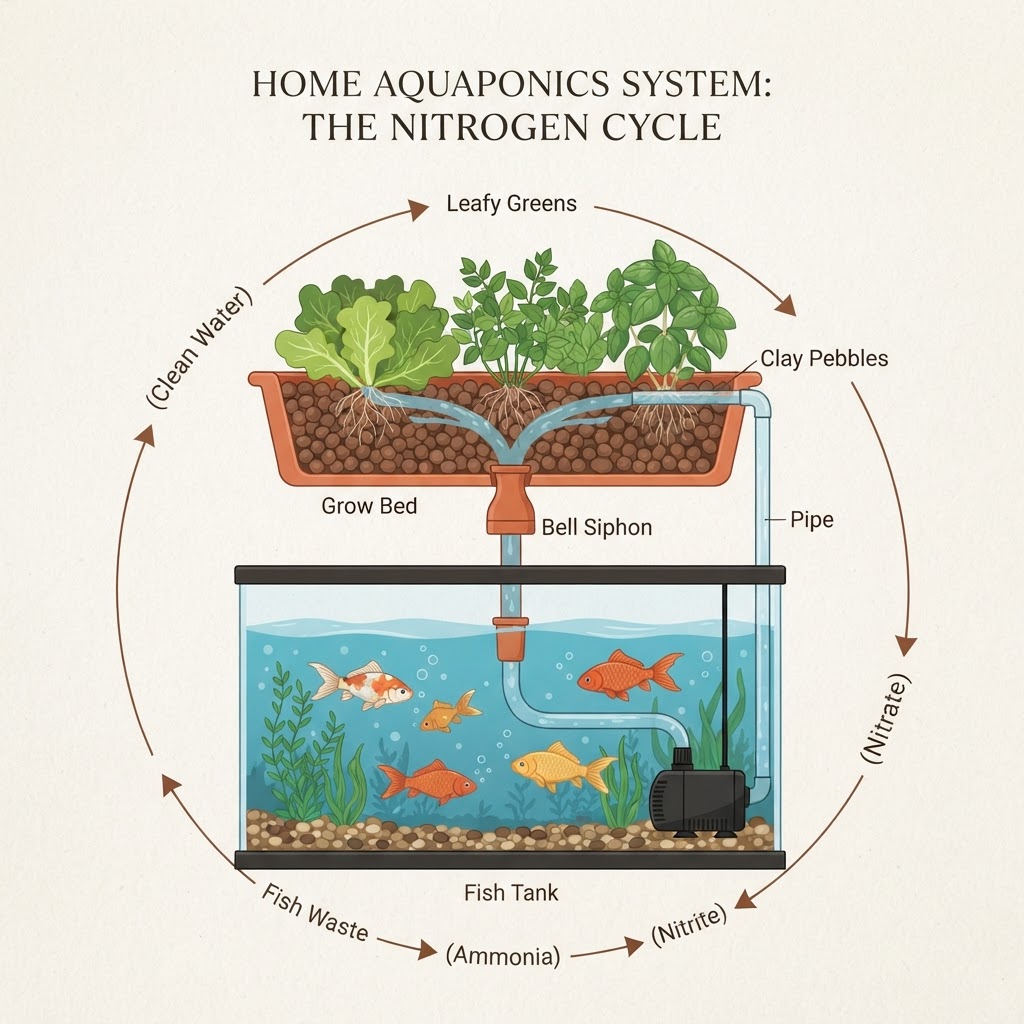
One loop, three partners.
Fish excrete ammonia. Bacteria living on the grow media convert it first to nitrite, then to nitrate — the form plants drink. Roots strip the nitrate out and the cleaned water flows back to the fish.
Because nothing is flushed away, a media-bed system uses about a tenth of the water of soil gardening and needs no fertilizer once cycled. Your only inputs are fish feed, a little electricity for the pump, and top-up water.
The build
Eight steps from tote to harvest.
- 01
Choose and clean your tank
A food-grade IBC tote (275 gal), stock tank or 55-gal barrel. Scrub with vinegar — never soap — and rinse until the water runs clear.
- 02
Build the grow-bed stand
Frame a stand from 4×4 posts and 2×6 joists so the bed sits above the tank rim. A full media bed weighs ~100 lb per square foot: over-build it.
- 03
Fit the bed and drain
Drill a 1¼" hole in the bed floor, seat a uniseal, and drop in the bell siphon standpipe. Set the standpipe height 2" below the media surface.
- 04
Plumb the pump
Run ¾" tubing from the submersible pump up to the bed inlet. Add a ball valve so you can throttle flow to match the siphon.
- 05
Wash and load media
Rinse expanded clay or lava rock until dust-free, then fill the bed to 12". Cover the siphon with a media guard.
- 06
Fill, dechlorinate, test
Fill the tank, run the pump and watch the siphon flood-and-drain a few cycles. Add dechlorinator and take baseline readings.
- 07
Cycle before fish
Fishless-cycle for 3–5 weeks with pure ammonia until ammonia and nitrite read zero. Use the planner below for the day-by-day schedule.
- 08
Stock, plant, maintain
Add fish at half density, feed lightly, transplant seedlings. Top-dress plant beds with PH Harringtons Bio-Mat in nearby soil beds to reuse tank water.
Livestock
Choosing your fish.
Tilapia
Fast, forgiving, edible. Needs warm water — plan a heater outside the tropics.
- Water
- 74–86°F
- Space
- 5 gal each
- Harvest
- 7 mo
Channel catfish
Hardy bottom feeder, tolerates lower oxygen. Great meat yield.
- Water
- 70–85°F
- Space
- 8 gal each
- Harvest
- 9 mo
Bluegill
Native, cool-tolerant, tastes great. Slower to grow.
- Water
- 65–80°F
- Space
- 8 gal each
- Harvest
- 12 mo
Rainbow trout
Cold water only. Pairs with lettuce and brassicas, not tomatoes.
- Water
- 50–65°F
- Space
- 10 gal each
- Harvest
- 10 mo
Goldfish
Ornamental, nearly bulletproof. Ideal for a first indoor system.
- Water
- 60–78°F
- Space
- 10 gal each
- Harvest
- Ornamental
Koi
Ornamental, long-lived, heavy nutrient producers. Needs a big tank.
- Water
- 60–78°F
- Space
- 25 gal each
- Harvest
- Ornamental
Crops
What grows well.
Start with leafy greens — they thrive on modest nutrient levels. Add fruiting crops once the system is mature and well-stocked.
Lettuce
low demand · 5 wks
Basil
medium demand · 6 wks
Kale
low demand · 8 wks
Spinach
low demand · 6 wks
Swiss chard
low demand · 8 wks
Cabbage
medium demand · 10 wks
Mint
low demand · 6 wks
Strawberry
medium demand · 12 wks
Pepper
high demand · 12 wks
Tomato
high demand · 12 wks
Cucumber
high demand · 9 wks
Upkeep
Ongoing maintenance.
Weekly
Test ammonia, nitrite, nitrate, pH. Target pH 6.8–7.0 — the compromise between fish, plants and bacteria.
Top up
Replace evaporation with dechlorinated water. Never change more than 10% at once.
Temperature
Keep within your fish's range. A cheap digital probe saves fish.
Monthly
Rinse the pump intake, check siphon timing, remove root mats blocking the drain.
Troubleshooting
When things go sideways.
Ammonia rising
Overfeeding or too many fish. Halve feed for 3 days; add media surface area.
Yellowing leaves
Iron deficiency — common above pH 7. Add chelated iron and nudge pH down.
Fish gasping at surface
Low oxygen. Add an air stone immediately; check the pump is running.
Algae bloom
Light reaching the water. Shade the tank and cover exposed pipework.
Siphon won't break
Flow too high or snorkel blocked. Throttle the ball valve, clear the snorkel tube.
pH climbing steadily
New media leaching. Rinse harder next time; dose pH-down slowly.
Interactive planner
Size your system.
Set tank and bed size, pick your fish and crops. We calculate stocking, pump, feed, media and a day-by-day cycling schedule — printable as a build sheet.
System configuration
Bed : tank 0.6 : 1 — sliders stay linked in the 1:1 – 2:1 range.
Lettuce
4 per sq ft
Basil
4 per sq ft
Kale
2 per sq ft
Spinach
6 per sq ft
Swiss chard
3 per sq ft
Cabbage
1 per sq ft
Mint
3 per sq ft
Strawberry
3 per sq ft
Pepper
1 per sq ft
Tomato
0.5 per sq ft
Cucumber
1 per sq ft
Aquaponics build sheet — 100 gal / 8 sq ft / Tilapia
Stocking
20 fish
Tilapia · 5 gal each
Pump
150 GPH
≈1.5× tank volume / hr
Daily feed
136 g
14 g while juvenile
Grow media
8 cu ft
5 × 50 L bags
Bed : tank
0.6 : 1
target 1:1 – 2:1
Plants
24
need 7 sq ft · 3 varieties
Aeration
4 L/min
air pump minimum
Water temp
74–86°F
hold for the fish
Grow bed is small for this tank (0.6:1). Aim for at least 1:1 bed-to-tank volume, or stock fewer fish.
Materials checklist
- 100 gal food-safe fish tank (IBC tote, stock tank or barrel)
- Grow bed ~8 sq ft × 12" deep (food-grade tub or lined timber frame)
- Submersible pump rated ≥ 150 GPH
- 5 × 50 L bag(s) expanded clay or ¾" lava rock
- Bell siphon kit (or standpipe + timer) sized for the bed
- 1" PVC pipe, elbows, uniseal or bulkhead fittings
- Air pump ≥ 4 L/min with air stone
- Freshwater master test kit (ammonia, nitrite, nitrate, pH)
- Dechlorinator and pure ammonia (for fishless cycling)
- Aquarium heater ~400 W
- 20 × Tilapia fingerlings
- 24 seedlings (12 lettuce, 8 basil, 4 kale)
- Fish feed (floating pellets, 32–40% protein)
- Optional: LED grow light for indoor systems
Cycling schedule
Day
1
Fill & dechlorinate
Fill tank and beds, run the pump 24h, add dechlorinator. Check for leaks and siphon timing.
Day
3
Seed ammonia
Add pure ammonia to ~2–4 ppm (or a handful of fish food). This feeds the first bacteria colony.
Day
7
Ammonia peaks
Ammonia reads high, nitrite still zero. Keep pH 6.8–7.2 and water 75–80°F to speed things up.
Day
14
Nitrite appears
Nitrosomonas are converting ammonia → nitrite. Expect a nitrite spike; do not add fish yet.
Day
21
Nitrate rising
Nitrobacter kick in: nitrite falls, nitrate climbs. Plants can go in now to use the nitrate.
Day
28
Cycle complete
Ammonia 0, nitrite 0, nitrate present. Add fish at half stocking, feed lightly for a week.
Day
35
Full stocking
Add the remaining fish. Transplant heavier feeders (tomato, cucumber) into the beds.
Day
42
Steady state
Weekly test; top up water; harvest greens on rotation. Enjoy.